


Arts + Architecture / Drawing Inspiration
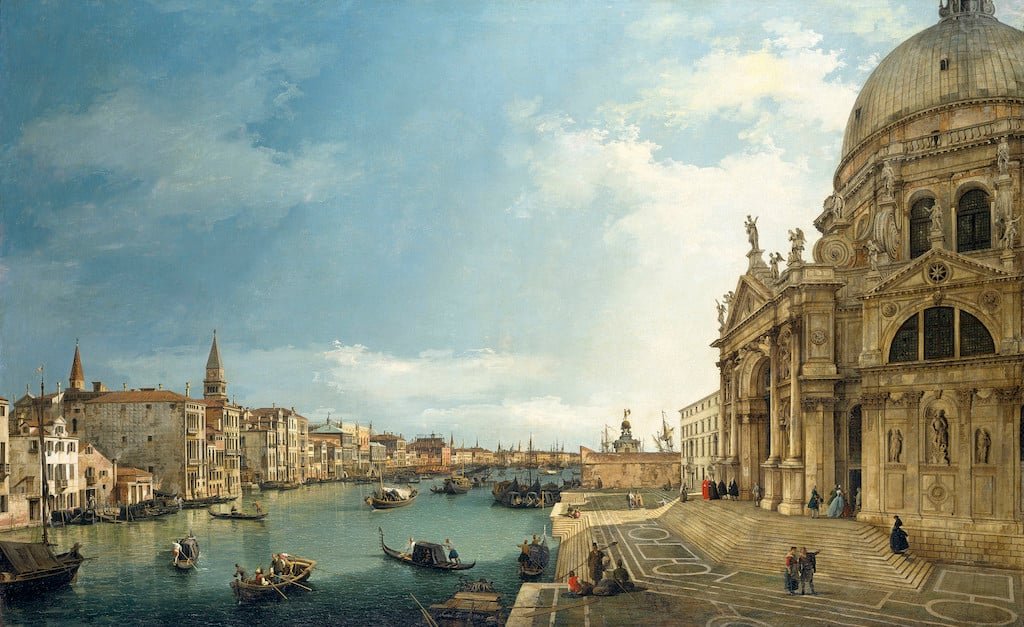
Venetian art is famous for its emphasis on rich color, light, and atmosphere, developing a distinct style from other Italian schools by prioritizing painterly effects over strict drawing, influenced by its watery setting, trade-rich culture (Byzantine/Eastern), and early adoption of oil paints. Key elements include vibrant pigments, glazing techniques, sensuous textures, and capturing shimmering light, seen in works by masters like the Bellinis, Titian, and Tintoretto, creating emotionally expressive and opulent visual experiences. Canaletto was the master of 18th-century Venetian veduta (view painting), known for his highly detailed, luminous, precise perspective and light effects.
In the 19th and 20th-century artists and architects on the Grand Tour looked at new techniques of capturing its unique light and architecture, including British painters like William Logsdail (known for his detailed Piazza San Marco) and marine artists like Edward William Cooke, alongside Italians such as Ippolito Caffi and Guglielmo Ciardi, and American John Singer Sargent, focusing on atmosphere, daily life, and iconic landmarks of Venice in watercolor sketches and oil paintings.
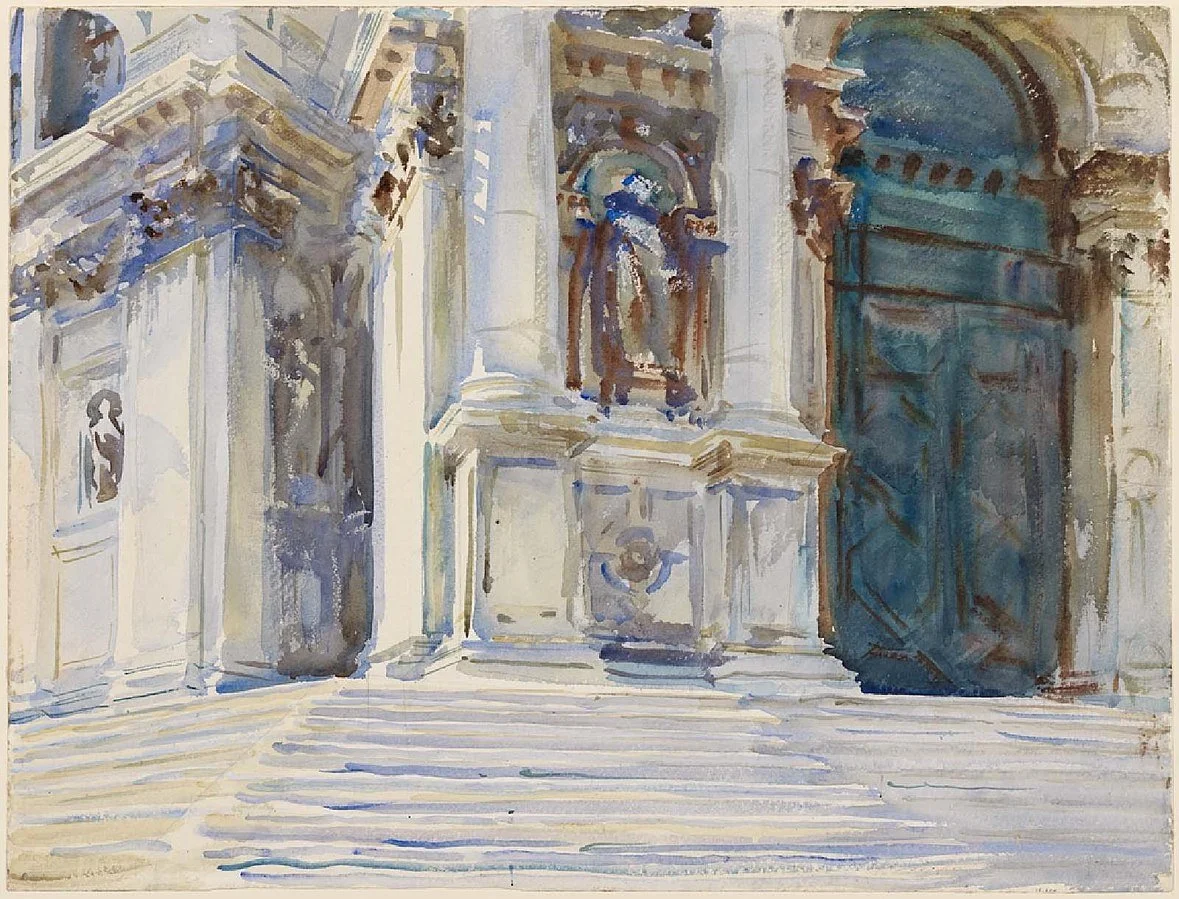
John Singer Sargent (1856-1925) / Venice Watercolors
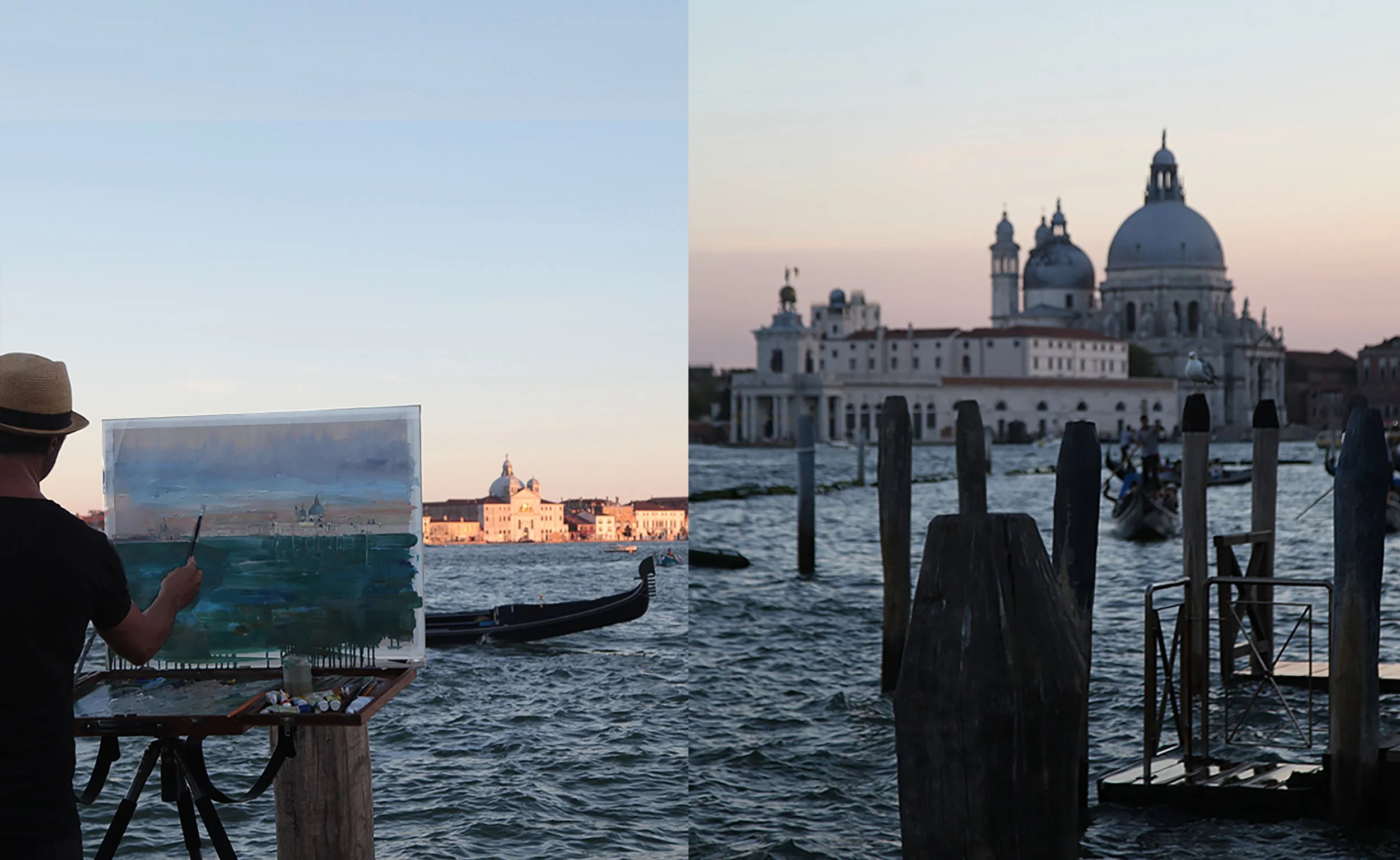
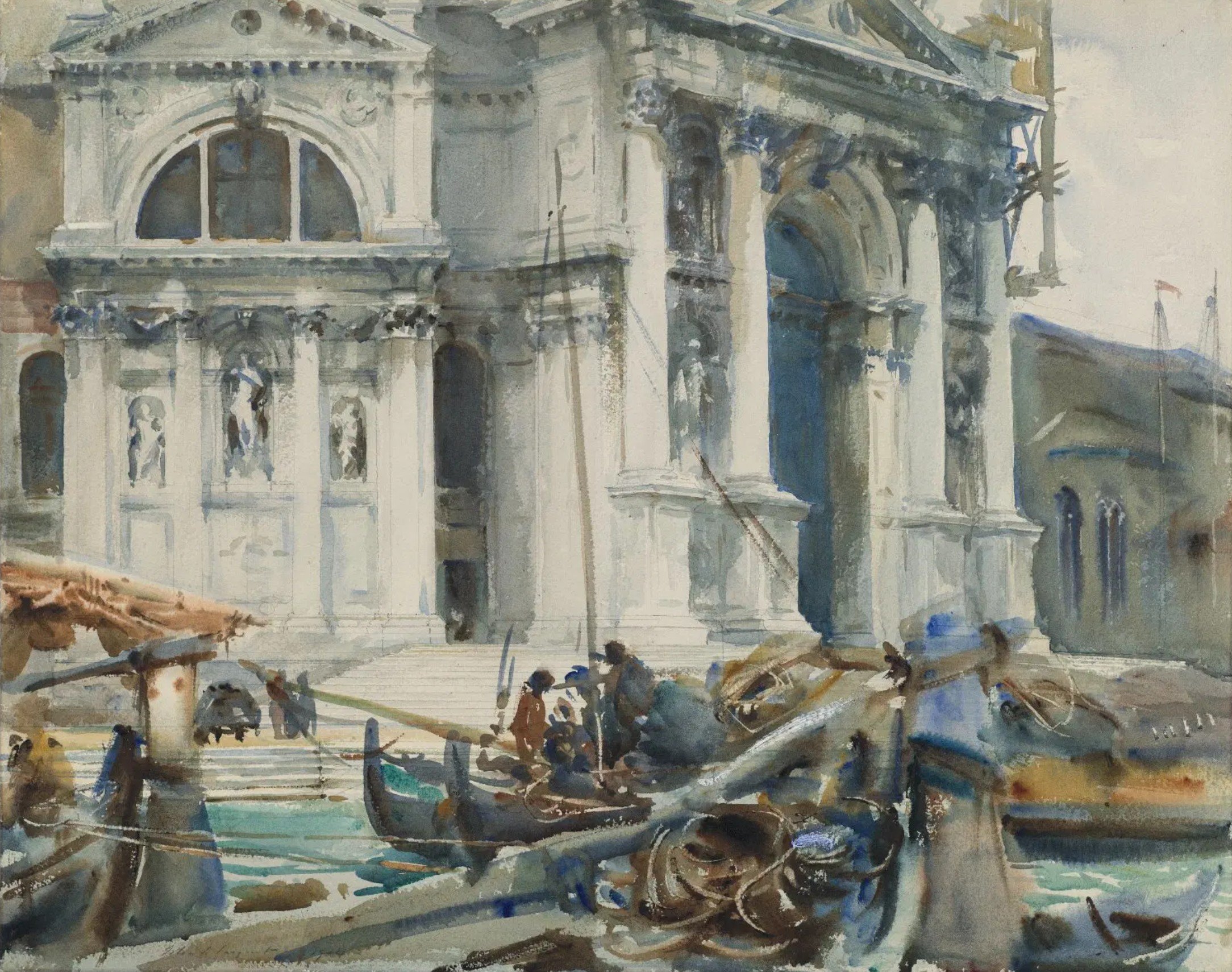
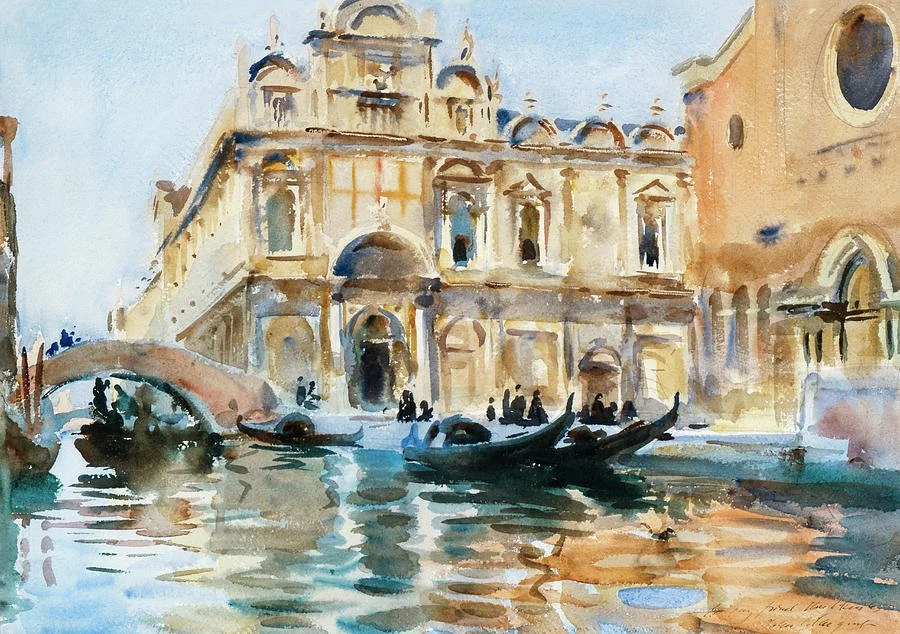
A+A was inspired by the idea of idea of retracing Sargent's routes down the Venetian waterways. John Singer Sargent, one of a few truly international artists of the 19th century, had a love affair with Venice. Between 1898 and 1913 Sargent visited Venice almost every year, attracted by a community of friends and colleagues who gathered there and by the city’s scenic possibilities. In Sargent’s image of Venice at dusk, details are obscured and forms are softened by the fading light, suggested by broadly applied, fluid pigments. Pools of color, accented by curving brushstrokes, evoke the gentle undulation of the murky water of the canal. Sargent presents another view of a sotto portego, or passageway, from a canal. His interest in the geometry of the scene, with its numerous horizontal and vertical divisions, is apparent in the carefully ruled underdrawing visible. The proximity of the building’s facade to the picture plane is underscored by the precise rendering of the bright white, carved spiral stone column at the left in contrast to the recession of the dark corridor. Sargent’s low vantage point and watery foreground suggests the experience of viewing the scene from a gondola on the canal, from which access to the city is limited. By leaving the illuminated area at the rear of the sotto portego ambiguous, Sargent evokes the tangle of streets and passageways so characteristic of Venice.
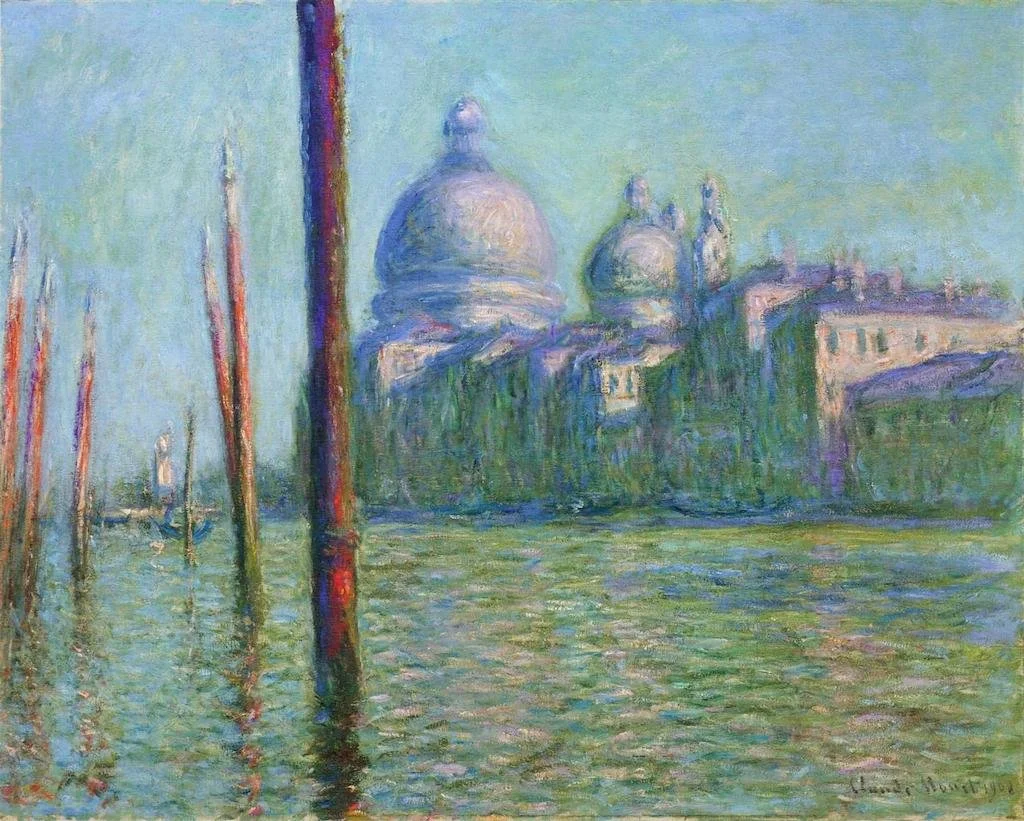
Claude Monet (1840- 1926) / Venice Paintings
"Monet and Venice" exhibition at the Brooklyn Museum (Oct 2025–Feb 2026) and then traveling to the Fine Arts Museums of San Francisco (Mar–Jul 2026), reuniting Monet's rare Venetian paintings from his 1908 trip with other works to explore his unique hazy, luminous style of the iconic city, offering an immersive sensory experience with art, music, and scent. Claude Monet's visit to Venice in the autumn of 1908 resulted in 37 paintings that captured its unique light and famous landmarks, such as the Doge's Palace and the Grand Canal, with a focus on atmosphere rather than detail.
Venitian Artists /
Giovanni Bellini (1430 – 1516)
Starting from the Early Renaissance, Giovanni Bellini certainly is the greatest exponent of Venetian painting. His favourite subjects were the Madonnas with Child and the Pietà series. Bellini paves the way for the so-called ‘tonalism’, combining the chromatic depth typical of Venetian painting with the plasticism of Piero della Francesca and the human realism of Antonello da Messina.
Where to find some of Giovanni Bellini’s works in Venice:
the Altarpiece of San Giobbe at the Accademia Galleries
the Triptych of the Frari in the Basilica of Santa Maria Gloriosa dei Frari
the Altarpiece Barbarigo in the Church of San Pietro Martire in Murano
Tiziano Vecellio (1488 – 1576)
Moving on to the Late Renaissance, Tiziano Vecellio is not only a well-known Venetian painter, but one of the most important artists of the entire Sixteenth Century.
Tiziano can be considered an innovator not only for his art but also for having transformed the role of artists within society: they became entrepreneurs, with their own workshop and collaborators. Tiziano is one of the greatest masters of colour and he deals with the most disparate themes: from religious painting, to mythological subjects, passing through allegories and portraits.
In 1513 Tiziano worked on The Battle of Cadore for the Doge’s Palace and he soon became the official painter of the Republic of Venice, creating numerous works for the city.
Where to find some of Tiziano’s works in Venice:
The Pietà at the Accademia Galleries
the Pesaro Altarpiece in the Basilica of Santa Maria Gloriosa dei Frari
The Martyrdom of St. Lawrence in the Jesuit Church
various works in the Doge’s Palace
“I never was so utterly crushed to the earth before any human intellect as I was today, before Tintoretto [...] he lashes out like a leviathan, and heaven and earth come together.
… that rascal Tintoretto — he has shown me some totally new fields of art and altered my feelings in many respects — or at least deepened & modified them — and I shall work differently, after seeing him, from my former method. I can’t see enough of him, and the more I look the more wonderful he becomes”
Tintoretto (1518 – 1594)
Among the greatest exponents of Mannerism is Tintoretto. About Jacopo Robusti – this was his real name – Jean-Paul Sartre said: “Tintoretto is Venice even if he does not paint Venice”. Known as ‘the furious’, his distinctive traits are bold perspectives, violent colours and scenographic light effects.
Where to find some of Tintoretto’s works in Venice:
Saint Mark frees a Slave and Stealing of the Body of Saint Mark at the Accademia Galleries
The wedding at Cana in the Church of Santa Maria della Salute
the decoration of the walls and ceiling of the Scuola Grande di San Rocco
various works in the Doge’s Palace
Tiepolo (1696 – 1770)
Giambattista Tiepolo was born in Venice in the parish of S. Pietro in Castello, near Sant’Elena, and represents the Venetian Rococo like no other. In his works he depicts the decadent society of nineteenth-century Venice and showcases great skills in assimilating and reworking in his own way the stylistic intonations of many artists.
Where to find some of Tiepolo’s works in Venice:
The Martyrdom of San Bartolomeo in the church of San Stae
various works in the chapel of Santa Teresa in the church of the Scalzi
the frescoes of the Gesuati church
The Nobility and Virtue that overthrow Ignorance at the Museum of the Venetian Eighteenth Century in Ca’ Rezzonico
Canaletto (1697 – 1768)
Giovanni Antonio Canal, better known as Canaletto, is one of the leading exponents of landscape painting. He is often remembered for the minutiae and abundance of details with which he painted Venetian palaces and canals.
Where to find some of Canaletto’s works in Venice:
The Grand Canal from Campo San Vio at the Rialto Bridge, The Grand Canal towards Rialto and The Rio dei Mendicanti at Ca’ Rezzonico Museum of the Venetian eighteenth century
The Capriccio with Colonnade and Courtyard at the Accademia Galleries
Various drawings at the Correr Museum